A 3D flower birthday card looks like a cutting project. It is a shopping project.
Two of the five files below build their whole bloom out of plain coloured cardstock. The other three ask for paper you cannot pick off a colour chart: patterned sheets, pearlescent, foil, and in one case a scrapbook stack named by brand.
That is the sort order here. Not prettiest first, and not easiest to cut.
Five files, ranked by how many sheets you would have to go out and buy on purpose.
So the answer to which flower birthday card you should make is the one whose published supply list matches the drawer you already own. Of the seven designs read for this piece, only five published that list at all, and two of those five needed nothing beyond plain coloured cardstock.
That ratio is the whole warning. A flower card is cheap to cut and expensive to shop for, and the shopping happens after you have paid for the file, when the legend finally tells you it wants a named scrapbook stack.
Quick answer
Every layered flower card ships with a PDF legend naming the paper for each piece. Read that list before you buy the file.
A card built from solid cardstock you can cut tonight from what is already in the drawer. A card whose legend says floral pattern, pearlescent or foil needs a substitution decision from you first, and a badly substituted sheet is exactly what makes a handmade card read as homemade.
The short version: the Sky Fantasy Flower Card asks for six solids and one sheet of silver foil, and it is the design here that a plain cardstock pack covers.
The flower is drawn in paper, not in the file
Open any two of these designs side by side and you will see the cut lines are related. Petals, a stem, a frame, a sentiment panel, all of it familiar.
What separates them is what the legend tells you to feed the machine. Four things decide that, and only one of them is the drawing:
- Solids: any cardstock in the right colour will do, so the drawer answers.
- Pattern sheets: a printed design you cannot mix, so you buy the named stack.
- Pearlescent: the sheen is the effect, and a matte sheet in that slot kills it.
- Foil: one or two accent pieces, cheap to buy, easy to forget.
Sky Fantasy builds a blue bloom from six solid colours and one sheet of silver foil. Fleurette builds a woman surrounded by flowers from fifteen solids and four sheets of printed pattern paper, one coral, one floral, one green, one orange.
Same machine, same mat size, same studio, same evening for you. The second one cannot be made from a rainbow pack.
Pattern paper is not a colour you can approximate. Swap the named floral sheet for a solid and the petals lose the thing that made them read as petals in the preview photo.
Substitution is where your evening goes wrong, and it goes wrong quietly. Nothing tears for you, nothing misaligns.
The card assembles perfectly and looks a little flat next to the picture you bought it from. My own first layered card did exactly that, and I blamed the glue for a week.
 Pin it
The four printed sheets are named on the page, coral, floral, green and orange, so you can check the drawer before anything is committed: Fleurette Greeting Card.
Why the flower shelf is smaller than the search suggests
Two sections feed this branch, and only one of them is where you should be looking. Greeting Cards 3D SVG holds 465 files; Paper Sculptures 3D SVG holds 8,257.
Layered greeting cards are a narrow shelf sitting next to a very wide one, and the flower cards you want are a slice of the narrow shelf.
That matters for your substitution. When a design calls for a specific patterned sheet, the answer is rarely another design that does the same thing in solids.
There are not that many to choose from, and the ones that exist mostly repeat the same three silhouettes. If the stacked look is what you are after rather than the card shape, layered paper art and shadow box files sit on a much wider shelf.
Five 3D flower card files, by specialty paper required
Five is how many carried a published supply list naming every sheet you need. A design whose page shows the finished card but never lists the paper does not appear here, because the whole point of the sort is the list.
 Pin it
No specialty paper: solid cardstock only
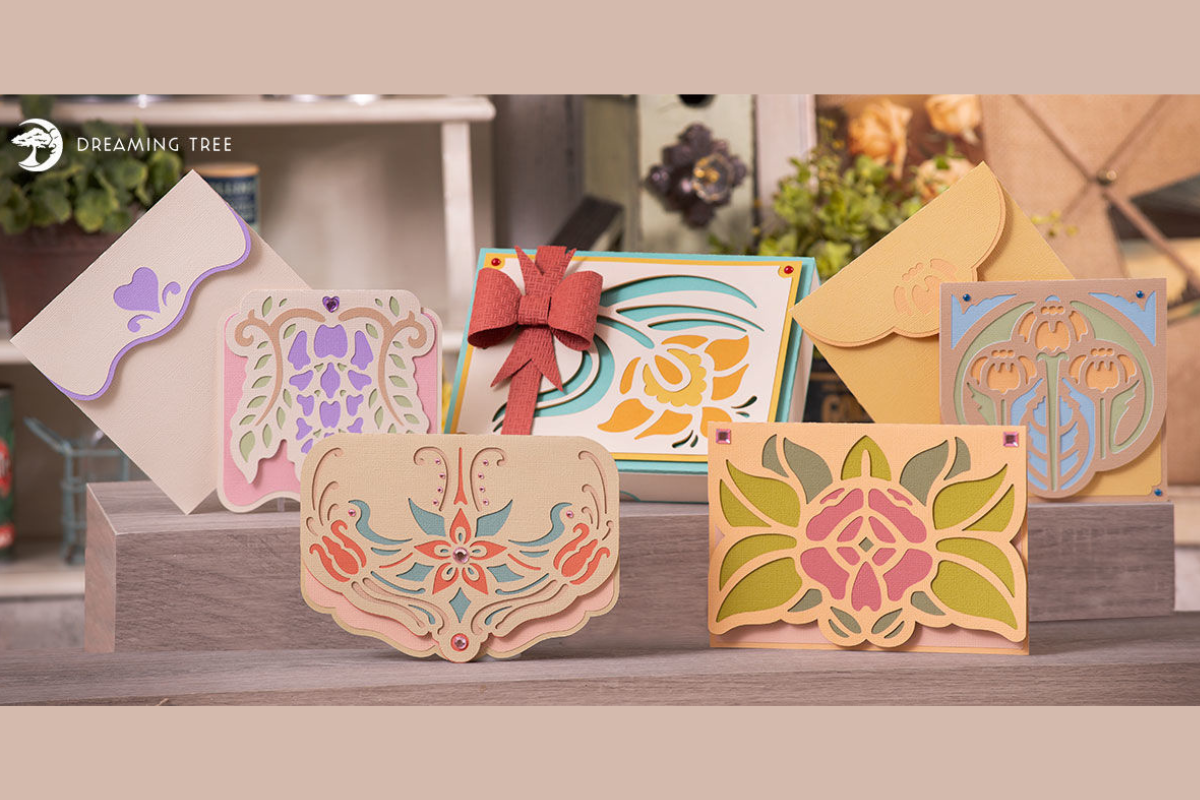
Nouveau Greetings SVG Bundle
Four cards plus a matching box, roughly two dozen sheets, every one solid cardstock, no patterns.
Best if you own a solid cardstock stash. Not for you if the drawer holds six colours.
One specialty sheet
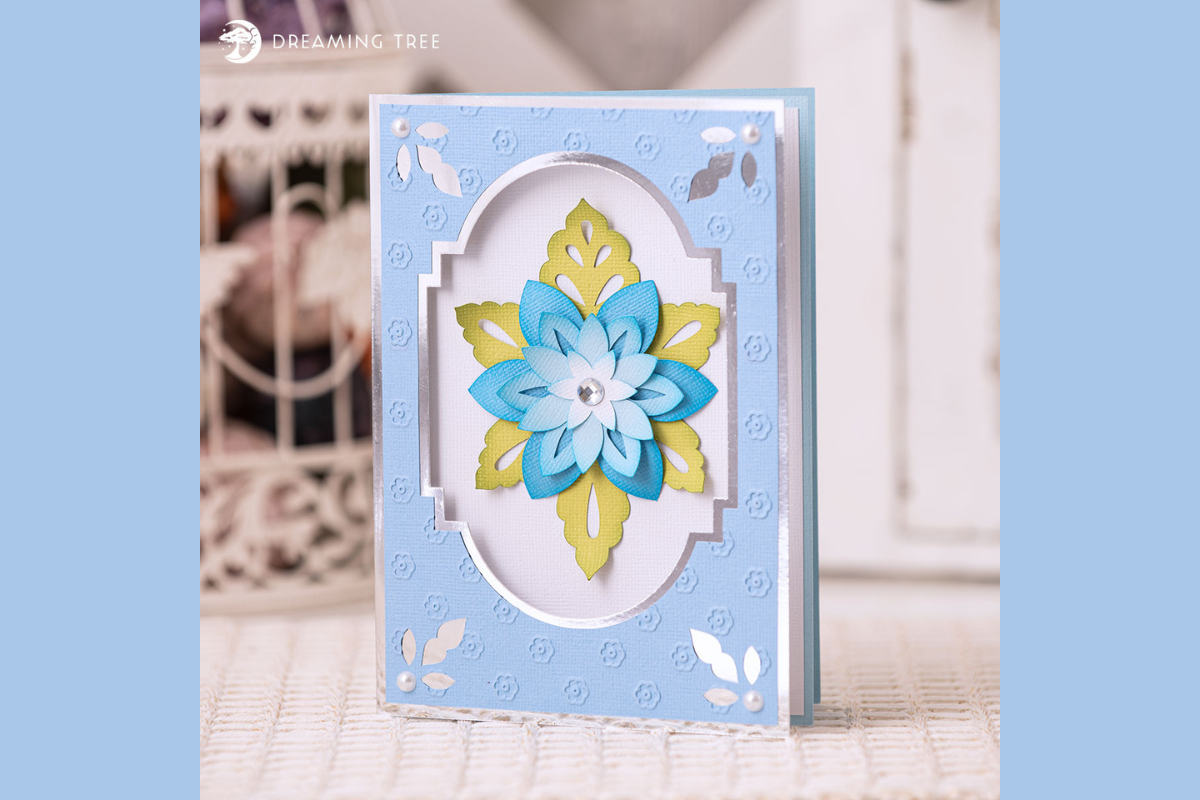
Sky Fantasy Flower Card SVG
Seven sheets for one blue-toned bloom: two whites, four blues, one silver foil for the accents.
Best if foil is the only sheet you need to source. Not for you if the recipient’s colours run warm.
Two specialty sheets
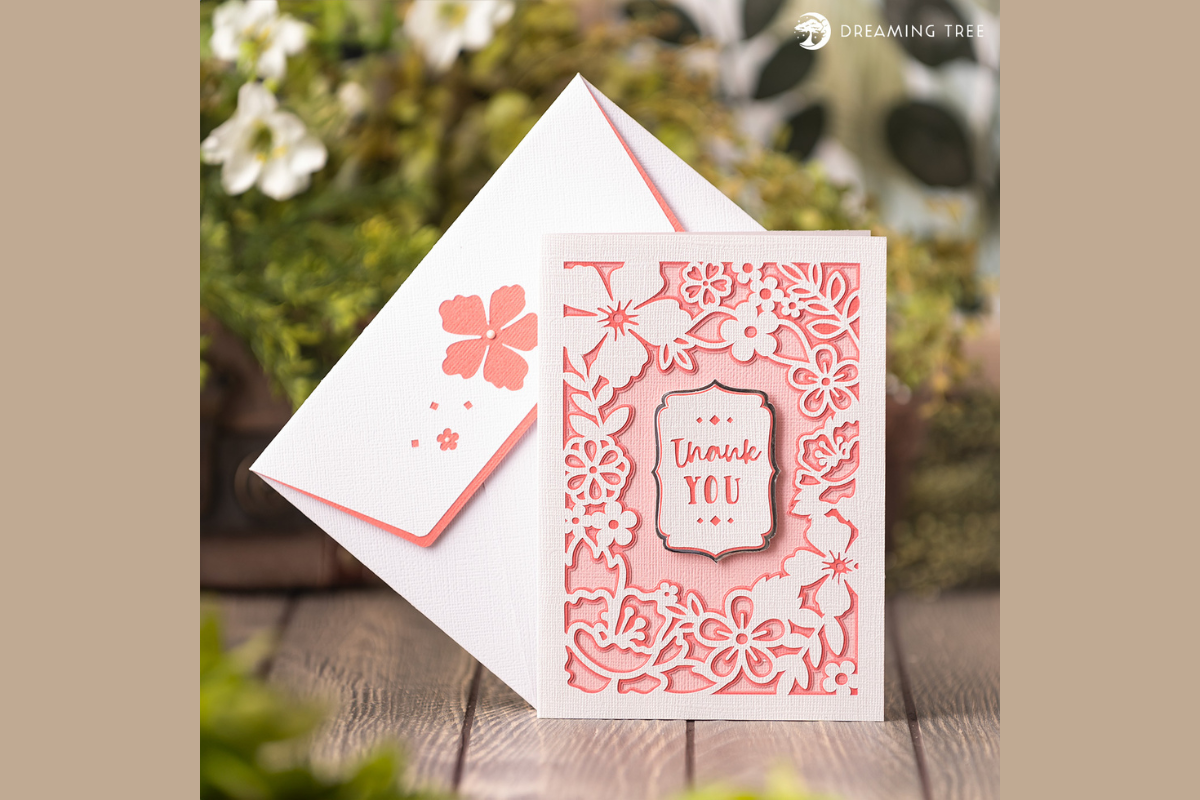
Floral Thank You Card SVG
Six sheets, a sentiment panel, and a step by step assembly video in the download.
Best if the panel can carry a birthday message instead. Not for you if the wording must be cut into the artwork.
Three specialty sheets, one of them named by brand
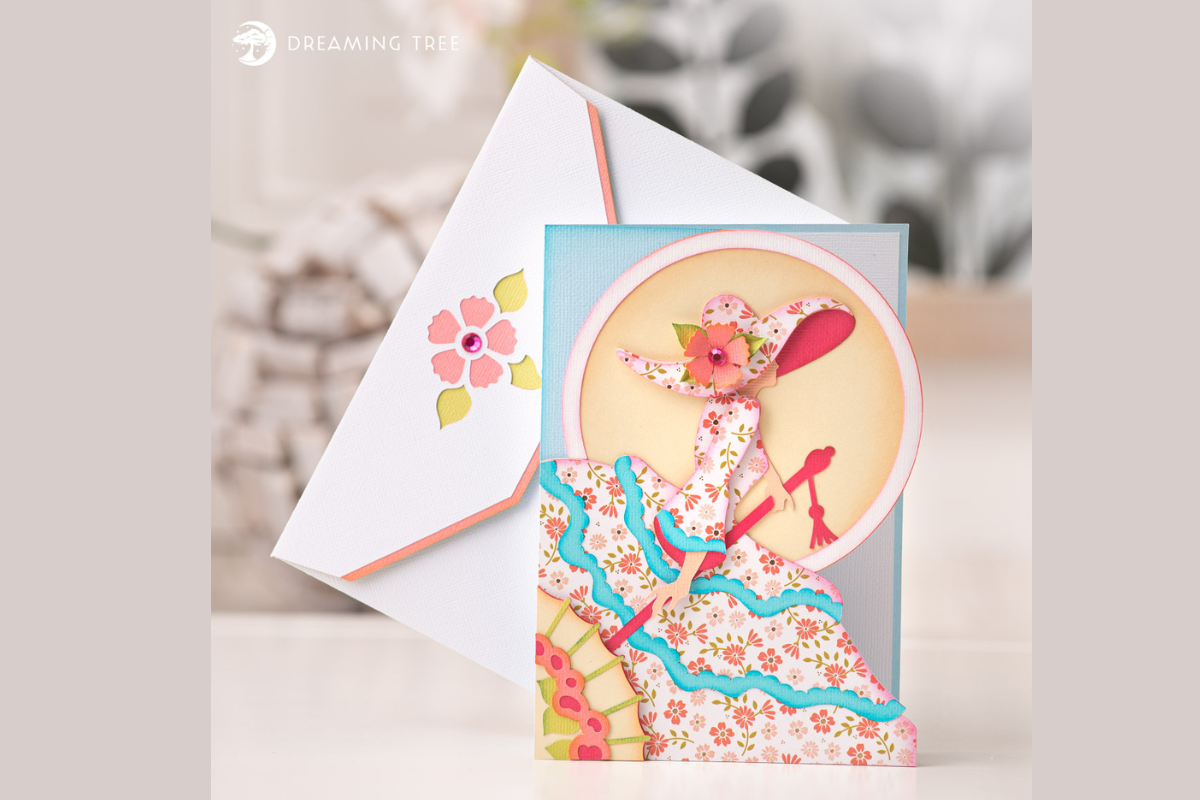
Belle Greeting Card SVG
Eleven sheets: eight solids, two pearlescents, one named floral pattern sheet.
Best if you keep patterned scrapbook stacks already. Not for you if you’d buy that one sheet just for this card.
Four pattern sheets: the full build
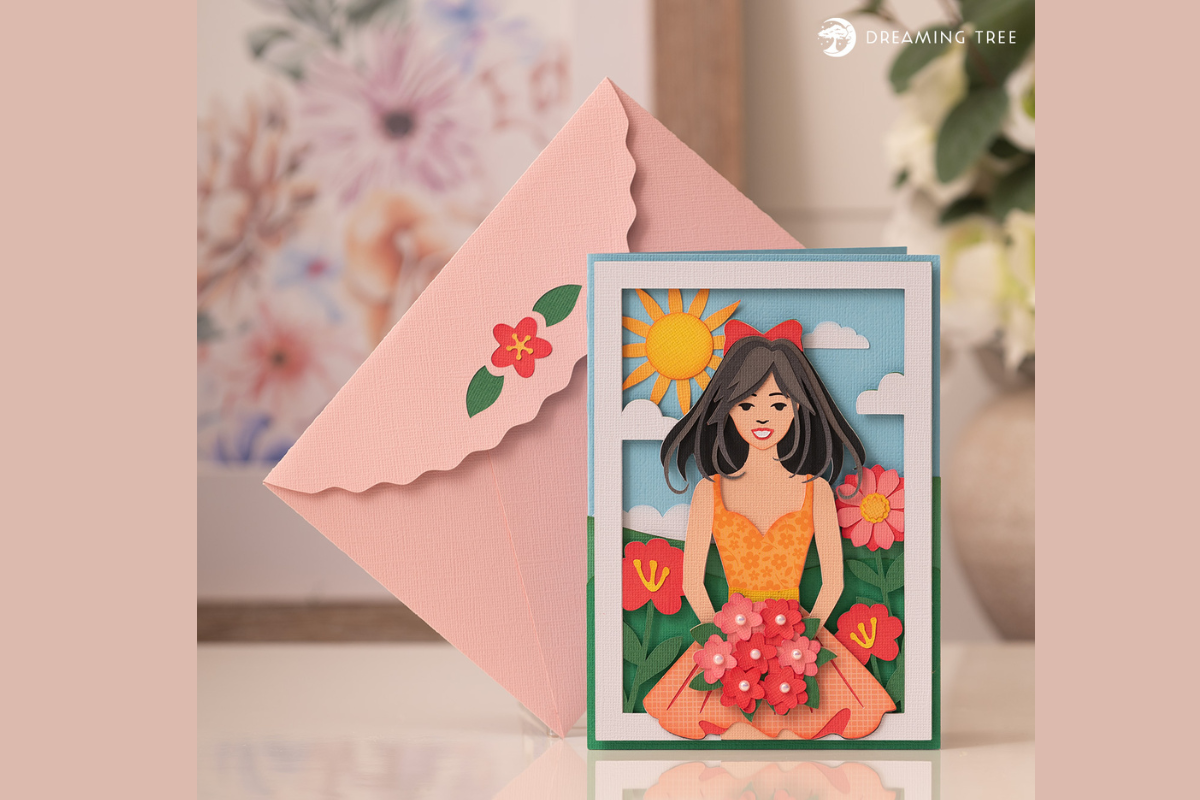
Fleurette Greeting Card SVG
The longest paper list of the five: fifteen solids and four printed patterns.
Best if the card is the whole gift. Not for you if the drawer is short on printed paper.
Two files that nearly made the list
The Butterfly Pop Up card sits in the same catalogue section, cuts at the same 7 by 5, includes an envelope and calls for seven sheets including silver vellum.
I left it off the list because it is a butterfly.
Lovely Layered Cards is a bundle whose contents are floral, but whose listing text describes a Christmas collection. Working out what you are actually buying means reading past the blurb to the file list.
Both are decent files. Neither answers the search that brought you here.
Keeping them off the main list is not a quality judgment, it is a fit judgment. A butterfly card and a Christmas bundle in floral wrapping both cost you the same evening to assemble as a flower card that actually matches the search, so the wrong pick wastes the same hour either way.
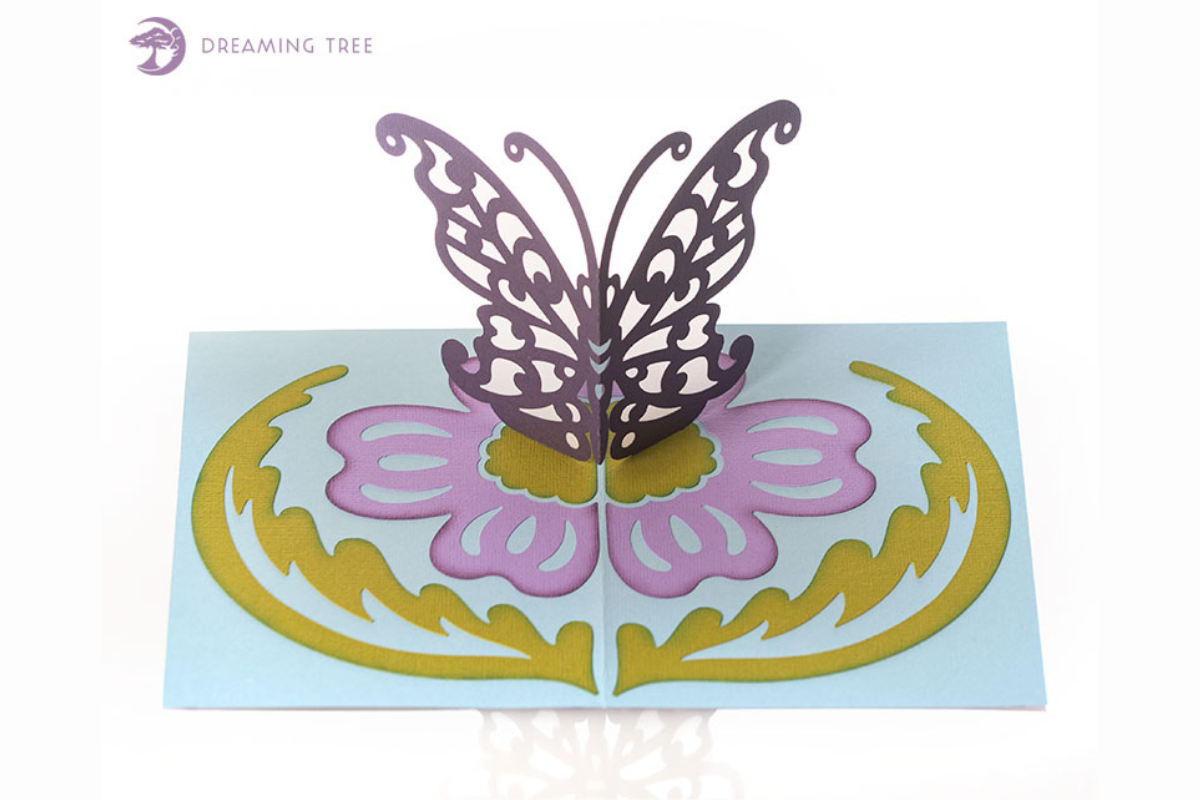
Butterfly Pop Up Card SVG
Seven sheets, one of them silver vellum, the only material here that lets light through.
Best if butterflies beat bouquets for this birthday. Not for you if you came for flowers.
When the birthday is not a flower birthday
Flowers are the safe layered card. They are not always the right one for your birthday.
If you are hunting a 3d cat birthday card or a 3d dog birthday card, you are searching the same catalogue section as these five, only a much thinner slice of it. The paper question changes with the subject, because pattern paper is what a flower asks for and a face is not a pattern.
A 3d car birthday card and a 3d football birthday card sit on that same thin slice. Read their legends the way you would read these, and check the sheet list against your drawer before the file is bought.
So the sort order you are reading does not carry over by itself. What carries over is the habit:
- Read the legend first, whatever the subject is. It is the only place the sheet list lives.
- Count the sheets you do not own, not the sheets the card needs in total.
- Treat a named brand stack as a shopping trip, not as a colour you can match.
- Check the wording cut into the artwork, because an all occasion card is not a birthday card.
I sort my own library by subject for that reason, not by how pretty the preview is. The animal pop-up card files are the closest thing to this list for a cat or dog birthday.
See every 3D birthday card file with a published supply list
What the free version does not give you
The supply list is the part you go looking for and rarely find.
A free flower card SVG usually arrives as cut lines and a preview image, which means the colours are yours to reverse engineer from a photograph.
| What decides the evening | Free file | Studio file |
|---|---|---|
| Named paper for every piece | Read off the preview photo | PDF legend, sheet by sheet |
| Which sheets are pattern or foil | Not stated | Listed separately from the solids |
| Finished height, width and depth | Rarely published | Stated on the product page |
| Matching envelope | Separate hunt | Included with several designs |
| Assembly order for the layers | Trial and error | Step by step video |
Browse layered flower card files with published supply lists
If the free file is what you have and the folds are what you are fighting, score lines in free pop-up card SVGs is the fix for that.
If you would rather sort by how many colours a card needs in total than by how many are specialty, that comparison is in 3D birthday cards you can finish in one evening. If the envelope is what keeps catching you out, start with Cricut birthday cards and the envelope they actually fit.
Flower birthday cards that are not layered at all
Layering is one way to put a bloom on a card, and it is the one that eats sheets. Three other builds give you a flower birthday card from a single colour.
- A cut silhouette. One sheet, the flower cut out of the front panel, a contrasting sheet behind it. No legend to read, because there is only one colour decision.
- A pop up bloom. The flower is a folded strip that rises when you open the card, so the depth comes from the mechanism rather than from stacked petals.
- A printed front. The bloom is printed, and your only paper choice is what you feed the printer.
I reach for the silhouette when the card has to post flat, because a layered bloom is thick enough to need extra postage and a cut front is not.
If the pop up route is the one you want, the guide to a pop up card that springs without tearing covers the strip cuts, and the Butterfly Pop Up Card SVG uses the same mechanism with a bloom on the front.
Which flower reads as a birthday flower
Here is the trap that catches a flower card and nothing else: a bloom on its own does not say birthday. It says thank you, or get well, or Mother’s Day.
That is why so many flower designs are sold as all occasion files. The drawing is deliberately neutral, and the occasion is supposed to come from you.
Three things put the birthday back in:
- A sentiment panel. The words sit on a separate layer, so you can cut Happy Birthday instead of Thank You from the same file.
- A number. An age cut into the frame or tucked among the petals fixes the occasion with no words at all.
- A candle or a cake element. One small shape borrowed from another file is enough, glued flat on the front panel.
Check this before you buy, not after. A file whose preview shows no wording and whose description says all occasion is a file you will be adding a layer to.
The Nouveau Greetings SVG Bundle ships sentiment panels as separate cut files for exactly this reason, and the guide to where the wording comes from covers the swap in detail.
Paper weight for petals that hold their curl
A layered bloom only looks like a bloom because the petals curl. Flat petals read as a sticker, and the curl is a paper weight decision before it is a technique.
| Piece | Weight | What happens outside it |
|---|---|---|
| Petals and leaves | 160 to 220 gsm | Lighter than 160 and the petal flops; heavier than 220 and it cracks white along the curl |
| Card base | 240 to 280 gsm | Below 240 the base bows under the weight of the stack |
| Pattern and foil accents | Whatever the sheet comes in | You cannot choose, so plan the base weight around it |
Curl the petal over the back of a bone folder, or a pen barrel, in one slow pass rather than three quick ones. I do it before any glue, while the piece is still easy to hold.
If a petal cracks, the sheet is too heavy for that shape and no amount of technique rescues it. Drop to a lighter sheet for the petals only and leave the base as it is.
For the stock that actually holds a curl at this weight, the flower card files with published supply lists name the weight alongside the colour, and the guide to handmade cards by paper weight explains why the two numbers differ.
A flower birthday card you print instead of cut
No cutting machine, no scissors patience, still a flower card. The printed route trades depth for speed and it costs you one sheet.
What you are looking for is a template with the bloom already rendered, sized to a folded A6 or a folded half of Letter, so one sheet makes one card.
- Print at actual size, never fit to page, or the fold line lands off centre.
- Score the fold before you bend it, even on printer paper, because a printed front cracks its ink along a hard fold.
- Use matte stock rather than glossy photo paper, which resists the fold and shows every fingerprint.
A printed card is the right answer when the birthday is tomorrow and the drawer is empty, and it is the wrong answer when you wanted the bloom to stand off the page.
The guide to templates that print without cut edges covers the margin settings for every printable here, and the birthday card file catalogue carries both printable and cut versions of the same blooms.

Questions people ask before buying a flower card file
| File | Specialty sheets it names |
|---|---|
| Nouveau Greetings bundle | None |
| Sky Fantasy | One |
| Floral Thank You | Two |
| Belle | Three |
| Fleurette | Four |
How to make a 3D flower card from a bought file, start to finish
Print the legend first and lay the named sheets out in the order the layers stack, darkest at the back.
Cut the base and the frame from the heaviest stock in the list, the petals from the lightest. Score before you fold, every time, and fold against a ruler while the cut is fresh, because cardstock stiffens as it sits.
Glue only the centre of each bloom so the outer petals stay loose enough to spring. Files that name a weight for each layer save you that guess entirely.
Give the glue a full minute before you stack the next layer, or the sheet slides a fraction and the petals stop lining up with the frame. The build is short once your paper is sorted; the sorting is the part people underestimate.
How to make 3D paper flowers when the file gives you a flat petal shape
A flat petal becomes a curved one with a bone folder and about ten seconds of pressure, drawn from the tip toward the centre. Roll the edge over the folder rather than creasing it, and keep your thumb off the tip.
Sixty-five pound stock curls willingly for you. Eighty pound wants a second pass and holds the curve longer once it takes.
Work in batches of five or six petals, all curved the same direction, or the bloom sits lopsided when you glue it and no amount of pressing at the centre fixes it afterwards.
That is why several of these designs name a lighter weight for the blooms and a heavier one for the panel behind them, and why one substitution can quietly flatten the whole face of the card.
What are the flowers for each birthday month, and do these files match them?
The month flowers are a real convention: carnation, violet, daffodil, daisy, sweet pea, rose, larkspur, gladiolus, aster, marigold, chrysanthemum, narcissus.
People search for them expecting one design named for each month. None of the five here is drawn to a named month bloom, so my answer is to stop looking for one.
They are generic layered flowers, which cuts both ways. Nothing stops you cutting a daisy design for an April birthday, and nothing in the file will make it read as a daffodil either.
If the month flower is the point of the card, pick the design by petal silhouette and let the colour do the naming. That is easier when the legend names every sheet by colour instead of leaving you to match a photograph.
Is a 3D flower bouquet greeting card the same build as these?
No, and in my experience it is the substitution people make most often.
A bouquet card is a pop-up: the flowers rise off a spine when the card opens, and the mechanism is what has to be cut accurately. These five are layered cards, flat-backed, where the depth comes from stacked sheets rather than a hinge.
A bouquet file wants lighter paper throughout so the mechanism folds shut. A layered card wants the heavy panel. Buying one expecting the other is how your supply list stops matching the drawer halfway through.
Will these files open on my machine?
They arrive as SVG, which Design Space, Silhouette Studio and the Glowforge app all accept.
What travels badly between machines is the score line. A layered card draws its folds as thin lines, and your software may import them as cuts, so look at every fold in the preview before you press Go.
Scoring by hand against a ruler is the fallback, and on a flat-backed card like these it costs you a minute. A file that ships with a step by step assembly video takes the guesswork out of which lines fold.
Can I substitute a solid sheet for a named pattern paper?
You can cut it, and it will assemble. Whether it works depends on what the pattern was doing.
On Fleurette the four printed sheets are the flowers, so solids give you a different card. On Belle the single pattern sheet sits behind the bloom, and a subtle solid you already own holds up fine.
What is pearlescent paper for in a flower card?
It catches light at an angle the way a petal does, which is why it turns up on the layers meant to look lit rather than coloured. A matte white in the same slot just reads as paper to the person opening your card.
Which of these needs the fewest sheets?
Floral Thank You, at six. Sky Fantasy is next at seven. Fleurette is the outlier at twenty for a single card, which is also why it takes you the longest evening of the five.
Do these files say happy birthday?
Not all of them. Several are drawn as all occasion or thank you cards with the sentiment cut into the artwork, so check the preview for the wording before you plan a birthday around it.
Are the envelopes included?
Sky Fantasy, Belle, Butterfly and every card in the Nouveau bundle state an included envelope. Fleurette and Floral Thank You do not mention one, so measure before you promise to post it.
What cardstock weight do these want?
Eighty pound cover, around 216 gsm, is what layered card designs are built around, and it is what I buy by the ream.
Lighter stock cuts more sweetly and then will not hold a raised petal, which is the entire reason you are making the card. Sixty-five pound works for the flat panels underneath, so the weight only matters where the card is meant to lift off the page.
How do I store the leftover sheets from one of these bundles?
Flat, in a folder or box a size larger than the paper, away from direct sun so your pearlescent and foil sheets keep their sheen. Mine live in a flat box under the desk.
Stacking loose sheets under other craft supplies is the fastest way to dent the raised finish that makes a foil sheet look different from a plain solid.
Where do I find a matching sheet when a named colour is out of stock?
Cardstock brands keep their named colours in a fixed line, so a search for the exact name on the paper brand’s own site turns up the closest match faster than guessing from a photo.
Craft store multi-packs rarely carry the specialty names at all, which is the gap these supply lists are built to close.
Does the card size change if I substitute a heavier or lighter cardstock?
The cut file stays the same size whatever you feed it, but the fold behaves differently.
Heavier stock resists the crease and can crack along a tight fold, while lighter stock folds easily and then sags under a raised petal. Matching the weight named in the legend is what keeps your finished card the height and depth stated on the product page.
If the question is which one survives a substitution, the answer is the Belle Greeting Card: solids only, no printed sheet anywhere in the list.
Related reading: birthday paper crafts you can finish the, how to make a 3d birthday card.
Key takeaways
- Read the supply list before you read anything else. It tells you whether tonight is a cutting evening or a shopping trip.
- Specialty sheets in this set run zero to four: Nouveau needs none, Sky Fantasy one, Floral Thank You two, Belle three, Fleurette four.
- A named brand stack in the legend is the strongest signal that your substitution will show.
- Sheet count and difficulty are different things. Twenty solids is patience; four pattern sheets is a sourcing problem.
- Not every layered flower card carries birthday wording. Check the artwork, not the tags.
If you want the shortest shopping trip of the five, start with the Nouveau Greetings bundle: four cards, one box, and not a single sheet you have to go out and find.